
When businesses start thinking about incorporating SEO into their marketing strategy, they usually want a timeframe. How long before they see an increase in traffic and search engine rankings?
The short answer is – it depends.
As an SEO copywriter, I’ve had clients who’ve seen their site catapult up the rankings within a few weeks and others who’ve seen less movement in more time.
If you’re considering adding SEO to your marketing mix consider your industry.
SEO Results Vary by Industry (do I have some type of image to represent these? Show a crowd scene for the first – my Plaza Foch pic would work)
1—Is It Highly Competitive? – Some industries are highly competitive online. Think marketing and most consumer goods. That means it could take at least a year or more to start showing up on the first page of the search engines with a consistent SEO push. Some paid search could make it go faster but it’s going to take a lot of resources to hit the first page.
In some cases, there may be too much competition for SEO to be a viable marketing tool for small businesses. Even larger businesses may need a multi-year strategy.
2—Low to Moderate Competition – With solid on-page optimization and consistent efforts in adding fresh and quality content plus developing (and implementing!) a linking strategy you’ll likely start seeing results in 3-6 months. (a scene without a lot of people)
Both of these hinge on having a clean website without technical problems.
Some clients who have experienced a quick ascent up the ranks offer a localized service in less competitive areas like naturopaths.
In B2B spaces with a low level of online competition, manufacturing for instance, you may find a few months of concerted effort finds your site floating to the top and your phone ringing a lot more. In fact, in some industries you can virtually dominate the online space within 12-24 months of consistent SEO efforts.
Ask yourself, are there a lot of strong online players in your industry? If not, would you like to be the leader?
If you want turn your website into a revenue generating powerhouse, you need a solid SEO strategy that starts with a strong foundation.
Laying the Foundation
There are some basic SEO elements to consider. I call it the foundation and it’s where I start all my SEO projects.
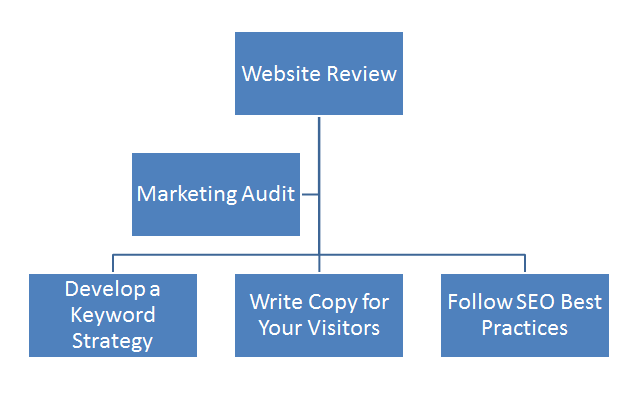
1—Website Review – I run it through a software program that “grades” your site from technical aspects like site speed to content. In my review, I can see if there are technical glitches the web team needs to look into and if you have enough copy (text) on your pages and if it’s optimized for your visitors. More on that in a minute.
2—Marketing Audit — I perform a rough marketing audit and ask you a series of questions related to your target market, competitive landscape and what sets you apart from others in your industry. This forms the basis of the new copy.
You can do this too. If you have buyer personas, pull those out and review the content on your website. Does it match their needs? If not, rewrite the copy so it does. Use their language.
3—Develop a Keyword Strategy – The cool thing about keyword tools is it’s a window into the mindset of your potential buyer. Type in “blue widgets” and you’ll get dozens of variations on “blue widgets”. These variations are the words your prospect is using. It’s up to you to decipher which ones are relevant of course but once you do, you can use the same language to describe your product and service.
Which do you think is more enticing? “The Blue Widget Guide to Successful Widget Production” or “Blue Widgets”
My thought is you’re more likely to click on the first one, no?
Keyword terms are so important they deserve their own blog post. You can read more about what makes a “good” keyword term and how to incorporate them into your copy here.
4—Write for Your Prospects Using the Language They Use – This is the crux of SEO copy. You’re not out to write thin, keyword stuffed content. You’re out to help your prospects solve a problem. You do that in benefit focused copy that speaks to your visitors. When you use the same words they do, they recognize that you’re speaking to them and Google recognizes that your website relates to their problem.
Weave them into the copy using the principles of SEO best practices.
5—Don’t Forget the <alt> Tags— Search engines are smart but they still can’t read images. All they know is there is a picture there. They just don’t know if it’s a dog or spaceship. Alt tags tell them what your picture is about. This means it can show up in Google image searches and give “points” to your web page.
You know how when you take a picture your camera assigns it a number like 1234567.jpg? Guess what, no one is searching for 12345678.jpg. If your picture and (your page) is about audio visual installations then rename it. Just make sure each picture has a different keyword term.
Here’s what it looks like in WordPress.

6—Meta-Data is Still Important –
- Title tag with keywords/keyphrases (70-85 characters/spaces maximum; real sentences are best) Think of this as a headline. This is what will show up in search engine results.
- Description: Use the same keyword terms to write a benefit-focused sentence or two. (150-185 characters/spaces). Think of this a mini-advertisement. Your goal is to get the click.
7—What are you saying? Your copy is critical.
Always write for your visitors. Keep your buyer persona in mind as you write each web page. Answer the questions your visitors have and keep it focused on how you solve their problems. When you write in a conversational tone and answer your visitor’s questions and format your content for the web (short paragraphs and sentences with sub heads) your visitors appreciate it.
Remember, they’re busy like you. If they landed on your website, they’re searching for a solution to a problem. Be clear about what you do and how you help solve their problems. You’ll build trust and likeability.
Addressing these components is an important piece of your SEO strategy.
How quickly you can address these elements will affect the timeframe too. It’s not unusual for an SEO engagement to start and three months later the approved copy is launched on the website.
It Doesn’t End There
SEO doesn’t end there. While some local businesses often see results within a few weeks, if your audience is national or international you’ll have more competition and you’ll need a longer term plan.
By its nature, SEO is an ongoing element of your marketing. Frequently updated content, a distribution plan and technical web elements all will improve your rankings.
How does SEO fit into your marketing plans?


